
- Video reading by Sae Bae
- Follow-up: The pillars of skilling
Skilling in OSRS is stuck. Most players don’t take it seriously and don’t care for proposals to make it appealing. They want the most XP for the least effort, with the somewhat justified belief that active skilling sucks and will always suck. Jagex has tried a number of ways to make it not suck and almost none of them have worked.
Community discourse centres on tick manipulation: knife-log, herb-tar, etc. used to start a 3-tick skilling timer. There’s a minority of skillers who like the current meta and don’t want it powercrept, and there’s a majority who want this meta disrupted by either outright removing tick manipulation or more cautiously by adding an item that starts the 3-tick timer in a single click. Sae Bae’s Knife-Log is Cannibalizing Skilling is a cogent polemic from the latter camp. Argument: whenever a skilling method comes out that competes with knife-log, Jagex nerfs it so that knife-log remains meta. Conclusion: knife-log is holding back skilling.
This debate is two camps talking past each other, but there’s a real issue buried inside:
- Knife-log skilling methods are far from perfect. They are repetitive and tedious. They are unintuitive and require precise setups. They lack progression, integration, and largely don’t have economic inputs or outputs.
- However, they are still better than competing active skilling methods. While knife-log skilling may be flawed, it does not suffer the great sin of being wholly uninteresting. There’s still a kernel of actual gameplay there that skillers enjoy, and for which no viable replacement has appeared.
How has Jagex managed to take PvM from Kalphite Queen to Vardorvis and from Fight Caves to Colosseum, yet for many skills the most interesting training methods are still 20+ years old? Why have they not managed to come up with anything better? What could they do to make skilling better? That is the burning question I’d like to investigate.
Let’s examine why players generally prefer PvM over active skilling. Then we’ll use what we learn to create some serious shake ups to the skilling meta.
First, the gameplay loop. What people mean by “gameplay loop” varies, so I’ll be specific. A gameplay loop is any pattern of behaviour the player repeats. They can be as short as seconds and as long as hours, days, or even years. The short loops are building blocks for the longer loops, and the long loops are motivations for carrying out the shorter loops. Most activities in OSRS comprise an expanding set of loops. Here’s a rough outline of the gameplay loops for a single PvM boss:
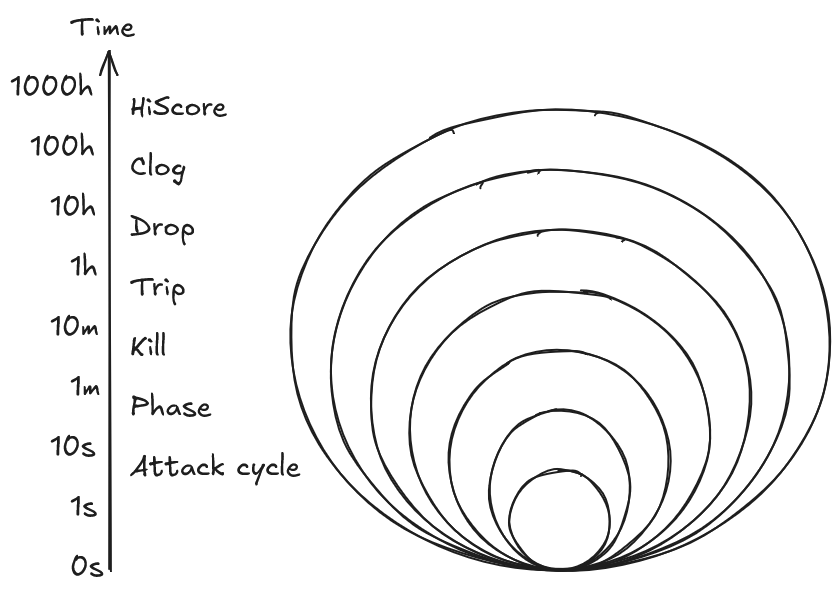
Just take a moment to marvel at the beauty of this. There is hardly another game in the world with gameplay loops as deep and layered as this. While most games excel on the finer details of their shorter and medium term loops, OSRS stands out for how tall it goes here.
Now let’s look at the gameplay loops for 3t4g (3-tick 4-granite, the meta active Mining method):
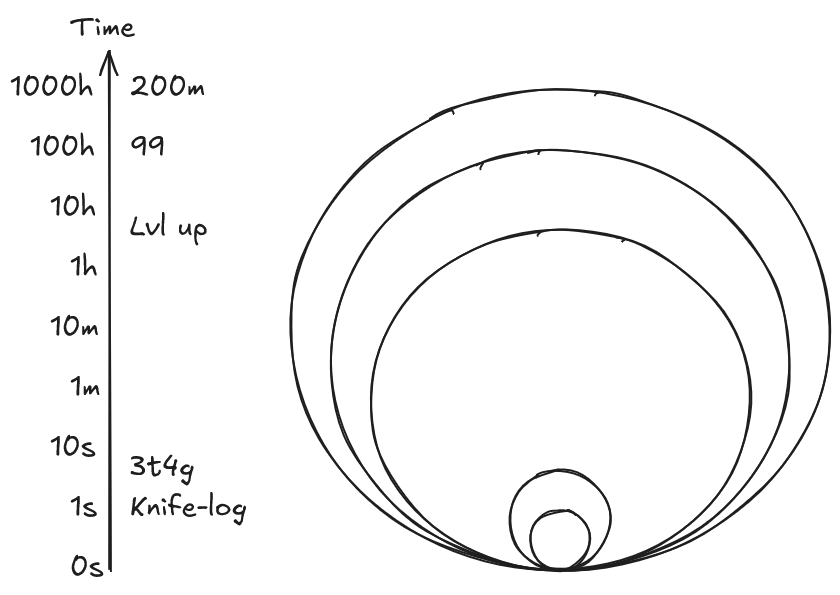
Not such a marvel, is it? There’s a big ugly hole in the middle. This hole is part of why the whole thing feels so repetitive. Even though the shortest and longest loops are roughly the same size as the PvM loops, your monke brain has to stretch far more than it wants to when jumping from “3t4g” all the way to “99”.
(I say “99” since that “Lvl up” loop is a stretch. The only meaningful unlocks after level 78 Mining are runite and amethyst.)
Now consider the gameplay loops for Shooting Stars:
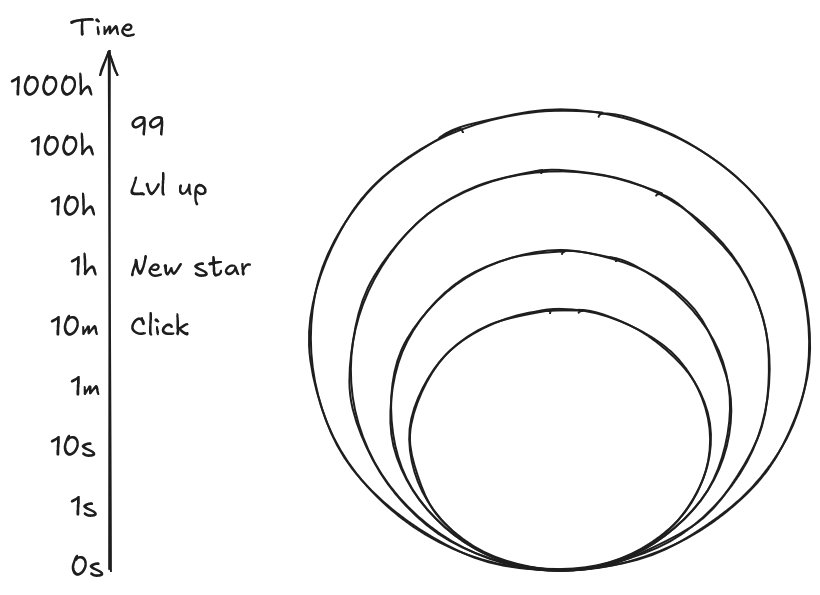
Nowhere near as layered as the PvM loops, but unlike 3t4g it doesn’t have any big holes in it. The gap between 0s and 10m can be filled in with whatever you want: gym sets, going for a walk, gardening; or let’s be real, doomscrolling. Contrast with the hole in 3t4g, which has no obvious and flexible way to be filled in. Is it any surprise that players gravitate towards this and things like it for their skilling grind, despite there being almost no actual gameplay?
Next is complexity. Again, what is meant by “complexity” varies, so I’ll be specific. There are also various forms, and we are only interested in some of them.
- Comprehension complexity is how difficult it is to understand what the game mechanic is.
- Strategic complexity is how difficult it is to figure out the optimal use of the mechanic.
- Execution complexity is how difficult it is to perform the intended strategy.
Comprehension complexity is the devil. It’s often a necessary cost to pay to get the other forms, but it should be minimized. It’s very easy to add comprehension complexity without getting any of the others in return.
For example, consider rock-paper-scissors. This game has low complexity on all three dimensions. What-beats-what is fairly intuitive (low comprehension complexity). Every option is equally strong, so the optimal strategy is fairly obvious (low strategic complexity). And the signs are easy to make for able-bodied people (low execution complexity).
What happens if you add more playable moves?
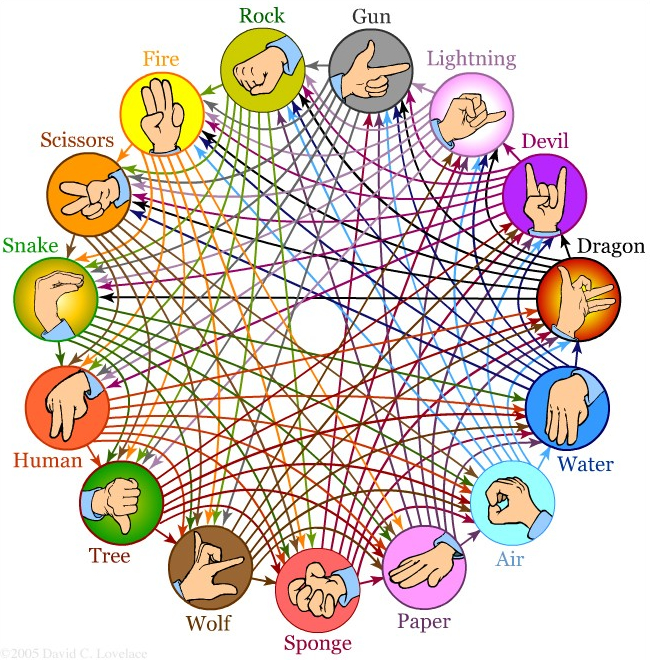
Without consulting the chart, what do you think the outcome is of Human vs Dragon? Wolf vs Lightning? Fire vs Air? The outcomes are now less intuitive, and there are a whole lot more of them. We’ve dramatically increased the comprehension complexity. And yet, what has happened to the other forms of complexity? The optimal strategy is still the same: play each move equally often. And they are still all easy-to-form hand signs (except for Fire… I can’t do that without pinching my pinky with my thumb).
Inventing such an RPS variant is quite easy. You just add more options. It’s not even really a concern that many of the outcomes don’t make much sense, since the game is not intended to be played. It does not offer anything new over classic RPS (other than impenetrability). Creating the game is the game.
Quite a lot of newer skilling content in OSRS follows this pattern. Mini-games and skilling bosses are the worst offenders. High comprehension complexity, not a lot of anything else. It will take you longer to learn how Zalcano works than it does to figure out what the best strategy to play it is. Once you know how it works, there’s no substance underneath.
Knife-log tick manipulation is high comprehension complexity with an associated high execution complexity. However, it still has little strategic complexity. This is okay for players who like games of this nature (rhythm games, shmups), but not so good for players who prefer high strategic, low execution complexity (CRPGs, TCGs, board games) or players who like a mix of both (most video games).
Most well-regarded PvM content also has high comprehension complexity. Consider Inferno or Colosseum. There are a dazzling number of game mechanics one has to make use of to clear them. Players need an intimate understanding of how the game operates in ticks and how this interacts with movement, prayers, consumables, attack timings, projectiles, dodging, safespotting, etc. But the content designer can expect the player is familiar with these because it’s endgame content. You’re not expected to complete them without a lot of prior PvM experience, where these mechanics are taught in easier, isolated, and/or lower stakes environments.
For endgame PvM, unlike RPS-15, this comprehension complexity pays off with an associated high strategic and execution complexity, which is generally what advanced players are looking for in active gameplay.
You might notice this ties in with progression. Generally speaking, lower level bosses have less complexity. As your power level grows, so does the complexity. It’s a good way to gradually introduce players to complexity so they don’t get overwhelmed. Graphically, it looks something like this:
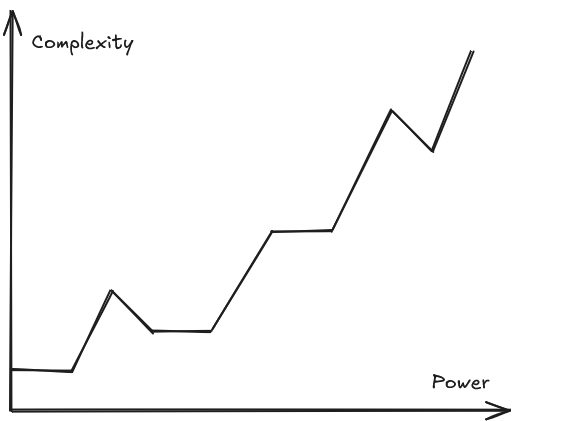
The flat lines are simple gear upgrades, e.g. going from adamant to rune gear. The lines going up are things that increase both power and complexity, e.g. unlocking protection prayers. The dips are things you unlock that both make you stronger and simplify the gameplay. They feel good to get, often in part because they simplify the gameplay, unlike e.g. unlocking a new weapon with new mechanics that you have to learn. But they don’t simplify it too much, and they don’t fully counteract the increase in complexity of other things you’ve unlocked. Some examples in OSRS are avernic treads and twinflame staff.
Skilling rarely has power increases that also increase complexity. It mostly goes the other way. Gathering success rates increase as you level up, so there’s less failed rolls that can disturb your rhythm. Typical gear upgrades: slayer helmet, colossal pouch, Runecraft cape, reagent pouch, alchemist’s amulet, auto-weed, bottomless compost bucket. All reduce complexity. Many skills only unlock easier variants as you get higher levels, Woodcutting being the prime example with its level 90 redwood trees unlock. These on their own are all reasonable QoL unlocks, but the lack of much in the other direction creates the bizarre situation where lategame skilling is simpler than early game skilling.
Next is input randomness. This is when randomness is revealed to the player before they act. For example, in Tetris, the game randomly decides which tetrominoes you have to work with, and you have time to adjust your inputs based on which piece was given. This differs from output randomness, which is randomness revealed after the player acts (droptables, fail rates on rooftop courses).
Input randomness helps make a gameplay loop feel less repetitive. Randomness that must be adapted to by the player makes consecutive runs feel more interactive and less stale, and unlike output randomness it doesn’t rob them of agency.
If we look at 3t4g, there is almost no input randomness. It isn’t zero. Sometimes the mining enhancers mean you need to drop 2 or 3 granite per mining action instead of 1. Sometimes you don’t successfully mine the rock and that can throw off your rhythm. But for the most part, this 20s clip of the 6h Mining record encapsulates the entire 6h video. You could use it to teach yourself the method in its entirety.
For most PvM, input randomness is a factor of two things. The first is that all damage calculations in OSRS are random, so your TTK and how quickly you get through each phase is randomized. On its own that’s mostly output randomness, but then the next factor is that the attack cycle is random. A boss with 3 mechanics in its attack cycle may use the same one 5 times in a row, or it may use them all roughly equally, or perhaps ends up cycling between the same two. Each kill is more or less difficult and uses more or less resources depending on which attacks the boss uses and how good your damage rolls are.
It’s also possible for the boss mechanic itself to have input randomness. Vardorvis’ swinging axes are a great example. There are 8 possible spawn positions for the axes, but each cycle only spawns 2 or 3. Where the axes spawn can have a dramatic effect on how difficult they are to dodge. This difficulty is also influenced by your current position and if there are other live mechanics you have to deal with at the same time, increasing strategic complexity (determining the best place to stand).
Some skilling methods make effective use of input randomness. Hallowed Sepulchre has input randomness via floor and arrow traps. (The flame-only traps on floors 4 and 5 eventually become a chore because they have no input randomness, despite being advanced floors.) Sailing’s courier tasks have input randomness via notice boards, requiring custom routing depending on which tasks are available. (Unfortunately, the tasks are not balanced well, so the optimal route at endgame is almost always collapsed to the same Aldarin → Rellekka line.)
The only knife-log skilling method with notable input randomness is 1.5t teaks. Because the trees fall at random, you have to adapt your movement and rhythm as they fall. This doesn’t just add execution complexity but also strategic, since there is an unclear tradeoff of which trees to focus on when a particular one goes down, and the correct strategy varies based on how accurate your clicks are.
Even with a 3x longer clip than the 3t4g one, you can’t get the full picture. When should you drop? How aggressively? When should you switch to the far tree? When should you use claw-vambs instead of herb-tar? Much harder questions to answer than with 3t4g all because of the input randomness.
(It’s often said that OSRS at a high level is really a rhythm game, but rhythm games typically have no input randomness. If you replay the inputs from a perfect run, you’ll get a perfect score every time. This is not the case for Vardorvis or Hallowed Sepulchre, but it is largely the case for 3t4g.)
Last is orthogonality. This is the degree to which things in the game cannot substitute for each other.
Consider a game with four available vehicles: a sedan, a truck, a sports car, and an ATV. These differ in aspects like durability, acceleration, max speed, handling, price, and storage capacity. Although they all have contexts in which they are the best choice, they can still substitute for each other to some degree, since the differences are all only a matter of numbers. Unless the designer has gone out of their way, players will be able to do everything in the game without using all of these vehicles. This is low orthogonality.
Contrast this to a game with only three available vehicles: a car, a boat, and a plane. You can’t use a car on water or in the air, so if a level requires you to travel across those, you’ll need to use a different vehicle. Because of this, the content design naturally lends itself to requiring players use all of the content in the game. This is high orthogonality.
Orthogonality is necessary for “integration” as Jagex calls it. The more things are not like each other, the more content you have to engage with to fit everything together. It’s what prevents the game from degenerating into a single optimal loop, where everything other than BiS and EHP becomes dead content. In OSRS, there are three main forms of this:
- Progression. Quests, XP, Boss KC, clogs. No amount of Fishing XP will get you any Mining levels.
- Economy. Most items are not like each other. Clay is not a substitute for glass.
- Game mechanics. In Hallowed Sepulchre, arrow traps and flame traps present unique challenges.
Progression is why players still do skilling at all despite its many flaws. It’s ultimately just a number, an entry in a database, but the depth and breadth of this orthogonality is unusual for a video game and where OSRS is at its strongest. If you want a quest cape, achievement diaries, or a max cape, you gotta get those levels up. No way around it. If players could get Agility XP at redwoods, you better believe those rooftops would be a ghost town.
Economic orthogonality is the main appeal of ironman mode, which makes collecting items more orthogonal. However, it is just as important for mains, since orthogonality also affects the profitability of skilling methods. This is most easily demonstrated with chinchompa hunting.
Chinchompas are a highly orthogonal resource. If you want their unique Ranged AoE damage (Ranged EHP by wide margin, defence bypass e.g. vs Kree’arra, 3x3 wave clear), you need chinchompas. And there is only one source of these, chinchompa hunting. This is why, despite being one of the fastest hunter training methods, chinchompas are still extremely valuable. There is not such an excess of supply as there is with darts/arrows from players training Fletching.
PvM has a wide range of both inputs and outputs. The inputs can be both consumable (potions, food, rune, ammo) and permanent (gear, utility, levels). The outputs are… basically everything. PvM acts as both the ultimate item sink and item source. This works well to make PvM self-contained, but it also encroaches on skilling as an item source. When PvM produces outputs that substitute for skilling outputs, orthogonality is lost and skilling ceases to be relevant for anything other than XP.
Because skilling has mostly useless outputs, nobody really cares that it’s boring, so there’s no interest in making it more interesting. It’s just a chore to progress your account. So players want skilling to be more AFK, since the activity has no ends in itself. And because skilling is boring, skilling isn’t allowed to produce significant outputs, because then players feel forced into doing boring content. Then, because skilling doesn’t have significant outputs, it isn’t expected to have significant inputs either, making it largely removed from any sort of item economy. At best it can be one directional, where the “skilling” activity produces a useful output but doesn’t grant significant XP. (If it grants XP, the output almost always becomes oversupplied.)
So skilling has over time become more and more of an economic dead zone. This is not news. People have been saying this since Zulrah was released over 10 years ago. But this is just one end. The other end is the actual game mechanics. This is what “skilling is boring” hints at. Orthogonal game mechanics enable content designers to remix familiar things into tough but fair challenges. Without it, content is eternally stuck being designed for beginners.
Consider Vardorvis. Here’s everything the content designer assumes you are familiar with:
- Melee combat. You have to be standing next to your enemy to deal damage.
- Aggro. Some NPCs only attack you after being attacked first.
- Pathing. What happens when you’re out of range? When an aggro melee NPC is out of range?
- DPS. What influences hit chance? What influences max hit? When is the damage dealt determined?
- HP, food, equipment, potions, teleports, general inventory/trip management.
- Protection prayers. What do they do? When do they come into effect?
- Ticks. OSRS is closer to turn-based than real-time, with each turn being 600ms.
- Attack speed, eat delay, attack delay.
- True Tile. Where things appear to be is often only an approximation.
- Movement. Run moves 2 tiles per tick and ‘skips’ the middle tiles.
- Interface management. Switching between inventory, prayers, and spellbook as needed.
That is quite a lot! But we can safely assume this since it’s lategame content. Then, on top of this, Vardorvis has four unique, orthogonal boss mechanics. Three can be on the screen all at the same time. They can be combined easily to change the difficulty, enabling multi-phase boss design (and the awakened version) without needing unique mechanics for each phase.
Contrast with Giants’ Foundry. The core activities of Smithing—smelting ores and hammering bars—are not used. The content designer has zero familiar game mechanics to work with. Every mechanic is new to the player, which means it has to be beginner level content.
Worse still, the mechanics it does introduce have low orthogonality. The trip hammer, grindstone, and polishing wheel all behave the same. You progress the preform by clicking and waiting. If the temperature is not right, or if it’s the wrong tool, the preform is damaged. Similarly, the lava pool and waterfall behave the same as each other. Click and wait and temperature goes up or down (with some randomness). None of these can combine or remix to create new gameplay loops. It’s just one step after the other.
Before moving on, let’s clarify the goal of this exercise. Another reason PvM is more popular than skilling is the intermittent rewards from random, rare drops. It’s habit forming in a way that any method that doesn’t rely on random drops will never be able to fully compete with. It creates an unhealthy relationship with the game and is why I personally do not like ironman and prefer skilling, despite all of the aforementioned upside of ironman and PvM.
Skilling needs something to distinguish itself from PvM. Otherwise, all we’re doing is recreating PvM with a new coat of paint. Historically the distinction was risk, but that’s a distant memory with death now a minor inconvenience at best. Today, the most sensible distinction is output randomness. PvM has lots of it. Skilling can go the other way: consistent outputs, the drops predominantly low variance, high frequency, and without long-tail rares. (Pets excluded of course!) I should not feel like my journey is substantially at the mercy of RNG.next(). Zalcano delenda est.
Given this distinction, active skilling is not aiming for total parity with PvM. Even if it’s brought up to scratch in every other way, it may still have less broad appeal (many people love hunting rare drops). It may also have more broad appeal (many people like me have an aversion to gambling). The goal is not “make skilling as popular as PvM” but “learn from PvM to make skilling better”.
(Update 13 Aug 2026) I’ve written about this further: The pillars of skilling.
It’s hard not to conclude that 3t4g should be powercrept. It is failing on almost all of the above considerations (big hole in gameplay loop, no input randomness, low orthogonality with no inputs/outputs and minimal mechanics), with its only standout benefit being some execution complexity. What replaces it has to maintain that execution complexity while improving on where it’s lacking.
This is not unprecedented. Although the bones are over 20 years old, 3t4g has been powercrept before. The current meta method is, with the April 2022 addition of the Necropolis mine, much easier than it was prior. I do not recall any massive protest from skillers when this mine was added. What skillers want preserved is not this very specific method in all its precise details, but the rhythmic challenge of knife-log combined with some amount of drop mining. This can be preserved while powercreeping 3t4g specifically to expand the design space.
So here are my suggestions to do just that, using what we’ve learnt from PvM. Their coverage is broad, but not tepid. There should be something to excite everyone in them.
First goal: Elevate manipulation of the skilling timer from an obscure engine exploit to a first-class game mechanic that content is designed around, much like how run tricks, prayer switches, and gear switches have been when designing PvM content. There are two components to this.
Component one is, yes, adding an item that starts a 3-tick skilling timer with a single click. However, this is not a one-to-one 1-click knife-log. (Try reading that one out loud.) I call it fairy dust. It’s stackable. It’s tradeable and plentiful, going on numerous loot tables in generous amounts, including on relatively low-level mobs like cave crawlers and fire giants. It’s also an output from various skilling activities that do not benefit from tick manipulation e.g. Hallowed Sepulchre and implings.
Its default left-click option is called “Scatter” (or perhaps “Sprinkle”) and consumes the item immediately, starting a 3-tick skilling timer, and at the end of the timer actually does something. That last part is important. The item needs an actual purpose outside of tick manipulation so that beginners still consider it useful. (Otherwise, comprehension complexity is much higher.)
In line with the flavour, the effect is that when scattered, there’s a small chance fairies drop a random item into your inventory. (Farming junk? Alchable? Seed? XP Lamp? Clue scroll?) Perhaps they’ll occasionally spawn a random event. Scattering fairy dust would be a low-effort (1 click queues 10 scatters), low-reward processing activity players can do while e.g. bankstanding. The value of these outputs should be high enough that the item is clearly useful even to players who don’t know what tick manipulation is. Aside from that, this gives an anchor to the market price. Anyone can profitably scatter dust that’s priced below the loot table’s EV, so the price can’t fall too far below it, the same way alch values anchor item prices. The loot table is a direct lever Jagex can use to tune the price independent of supply.
If you interrupt this scattering with something else (as you would when skilling), the fairies will not feel so generous. So you will be consuming 1 fairy dust just to start the 3-tick skilling timer. At max efficiency, that’s 2,000 fairy dust consumed per hour. If bought for 100gp each, that’s 200K gp/hr spent on fairy dust.
That’s not all. There is a second thing you can do with fairy dust, which is you can use it on a tool. If you use fairy dust on e.g. a pickaxe, harpoon, or axe, then you will scatter the fairy dust onto that tool, starting the 3-tick timer with 2 clicks. Sound familiar? This is knife-log, but with the twist that any XP drop on that skilling timer is boosted by a small amount: big enough that players feel rewarded for doing the 2-click method, but small enough that players don’t feel obligated to do so, and also small enough that it can be sensible strategy to stick to the 1-click method sometimes.
Also, having shown two videos now of EHP records, I would be foolish to overlook some very important ergonomics. Fairy dust will also come in variants so you can have it in multiple different inventory spots at once. Colour should do, e.g. green fairy dust, blue fairy dust, etc. (Matching Zanaris colour scheme?) They’d be functionally the same for skilling.
This design accomplishes multiple key things:
- Provides an on-ramp to tick manipulation matching knife-log XP rates with lower execution complexity.
- Preserves the knife-log technique as EHP, but with a smaller gap between it and the next best method.
- Preserves literal knife-log as still useful if one wants to do active skilling with fewer inputs.
- Has value to players who don’t care for active skilling and/or tick manipulation.
- Adds an input to training methods that otherwise don’t have one, adding economic orthogonality.
Component two is a total rework of Wintertodt. Wintertodt is an abomination. It turns an item sink skill into one which produces massive amounts of outputs from all three gathering skills without any inputs at all. It’s so imbalanced for early-game ironman that almost every guide starts with “rush 50 FM and spam WT for all your mats”, defeating the point of the game mode: being forced to engage with more varied content. It’s AFK content that you can’t actually AFK because your action can be randomly interrupted at any moment. Fortunately, it’s also the perfect opportunity to introduce players to awareness of the skilling timer, because the core activity of firemaking happens to be the best way to do that.
The gameplay of this new Wintertodt revolves entirely around actual firemaking. That is, using a tinderbox on a log. There are no bruma roots or fletching kindling or bruma herbs or crafting rejuvenation potions or any other total nonsense that only adds comprehension complexity. This is a Firemaking activity. You are going to make fires. And you have to bring your own damn logs.
The layout of the arena is the same. There are four quadrants surrounding the Wintertodt. Each has a brazier manned by a pyromancer who deals damage to the Wintertodt over time. Your job is to keep the area around the braziers warm enough that they can remain lit and so the pyromancers can DPS the Wintertodt down.
The Wintertodt will regularly spawn blizzards on a random 3x3 space in the arena, destroying any nearby fires in the process. These blizzards make the nearby braziers colder for every tick they remain active. If the braziers get too cold from these blizzards, their flame goes out and the pyromancer won’t be able to damage the boss anymore. The pyromancer will keep trying to relight the brazier, but will only be able to if there aren’t any nearby blizzards.
Standing inside of a blizzard for more than 2 ticks deals moderate damage each tick. Wearing warm clothes reduces this per item worn, and wearing zero warm items makes it always lethal damage. (You should never fight the Wintertodt without any warm clothing!)
Blizzards can be dealt with by lighting a regular fire on any square in its 3x3 space. You can left-click the blizzard to automatically move to the centre of it and light a fire. You can of course also manually move inside the blizzard and tinderbox-log for the same effect, which is how you’d light a fire on any of the outer edges.
When a fire is lit inside a blizzard, it immediately becomes inert and stops dealing damage or disrupting nearby braziers. The player who lit the fire gets contribution points. Inert blizzards stick around for a few ticks before disappearing (so multiple players can get contribution points off of it).
You may have figured out that if you don’t do any tick manipulation, you can’t light fires inside the blizzards without taking damage. That’s the whole idea. You need to learn how to do it. Fortunately, this is not so hard. The combination of fairy dust and the left click option on blizzards makes it as simple as standing next to a blizzard, left clicking fairy dust, then left clicking the blizzard. Congratulations, you did a tick manip!
We could add other boss mechanics to make this more engaging, e.g. falling icicles or maybe some kind of giant frost laser to dodge. But the core gameplay loop is dealing with blizzards via regular Firemaking.
Now to accommodate players who don’t care for active gameplay. The squares immediately next to the braziers can have fires lit on them too, and these fires can never have blizzards spawn on them or take them out. If there is a fire on one of these squares, nearby blizzards won’t cool the brazier down as quickly. So you want to make sure there’s always a fire here. How do you keep a fire alive forever? Forester’s fires! Adding logs to a forester’s fire next to a brazier also grants contribution points, but much fewer than actively dealing with blizzards. Also, since these squares are closest to the Wintertodt, wearing warm clothes is a must. If you aren’t wearing multiple warm items, you’ll take small damage every few ticks from the cold.
The rewards could stay the same, or Jagex could tune them a bit while they’re at it. The eco problem was never the exact outputs, but that there were no inputs.
All together, this rework:
- Teaches players the basics of tick manipulation.
- Maintains Firemaking’s original purpose as an item sink for logs, reintroducing economic orthogonality.
- Increases strategic and execution complexity, with roughly equal comprehension complexity.
- Makes the input randomness engaging (chasing blizzards) rather than frustrating (interrupting AFK).
- Is better suited as AFK content for players who prefer passive gameplay.
But wait, there’s more! When you talk to Captain Kalt in the Wintertodt Camp with the requisite level 50 Firemaking, he’ll give you this cape.
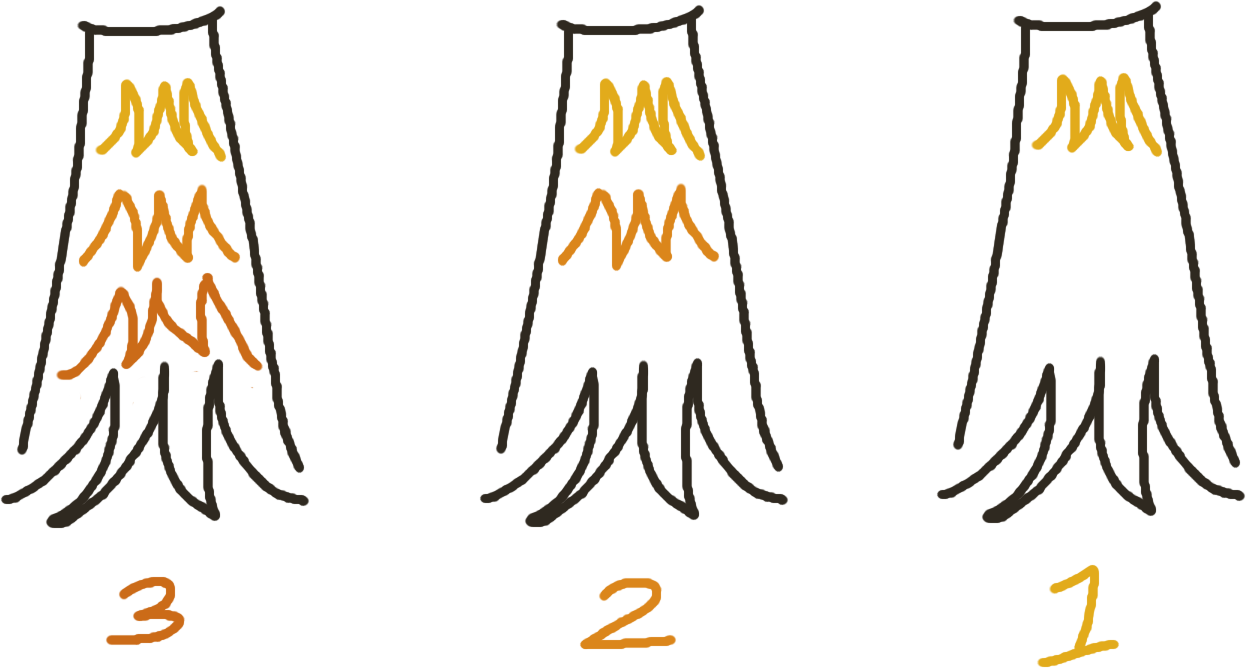
It changes how it looks based on the skilling timer. He’ll explain the significance of this, in particular when it comes to fighting the Wintertodt. And next to him will be a blizzard that he instructs you on how to put out safely, with a free, one-time gift of fairy dust to help you do so.
Second goal: Create a new mining method that is more interesting than and powercreeps 3t4g. This one has three components.
Component one is expanding the design space of mining sites by adding more competitive rocks, as the current design space is saturated.
It’s currently pointless to design a new mining site for active mining because all efficient rock formations already exist. Iron, granite, and gems are the only competitive rocks, and all three have sites where you can mine them with full uptime at no cost.
Solution: increase the mining success chance of gold/coal/mith/addy rocks. Make them roughly the same as granite. This would make them function similarly to gem rocks, where the long respawn times mean you need a large mining site to maintain full uptime. For reference, here are the current numbers:
| Rock | XP | Respawn time | Success rate |
|---|---|---|---|
| Coal | 50 | 50 ticks | 39.5% |
| Granite | ~62 | 9 ticks | 68.2% |
| Gem | 65 | 99 ticks | 82.4% |
| Gold | 65 | 100 ticks | 29.7% |
| Mithril | 80 | 200 ticks | 19.9% |
| Adamantite | 95 | 400 ticks | 10.1% |
(Success rate is at 99, and for gems with a charged glory equipped.)
If you could somehow get 100% uptime on 3-tick mining for mithril or addy rocks, this powercreeps 3t4g. Full uptime on addy rocks would increase EHP from ~126K to 184K XP/hr. A massive jump! But… there aren’t any mining sites with enough addy rocks to do that, let alone in convenient formations. We haven’t actually powercrept anything yet, just laid the groundwork for doing so.
However, even this change alone does enable some new competitive training methods like mining addy/mith/coal rocks in the Jatizso mine and using Superheat Item on them. Very crude estimate is 80K Mining XP, 12K Magic XP, 9K Smithing XP, and 500K gp (from bars) per hour. Also would be insanely difficult: complicated routing, juggling items on the ground, remembering which rocks you’ve used mining gloves on, using Superheat Item while doing knife-log, dealing with ice troll aggro.
Existing sites like the Kandarin Coal Trucks could become useful with minor changes: not gating capacity behind achievement diaries, since it’s an early game site; increasing capacity to more reasonable trip sizes; and putting a bank deposit box in the collection house.
Component two is giving the crystal pickaxe a real special attack. Crystal tools are perfect candidates for giving gathering skills meaningful inputs and a power-complexity curve, and the pickaxe is notably useless for active mining, unlike the harpoon and axe which have increased success rates.
New spec is this: The next successful mining action delivers a powerful blow that strip mines all rocks within a 3x3 area of the target rock. Aside from the spec bar cost, it costs extra charges per rock affected.
With this, we get another tool for designing mining sites. The ideal formation would be a big clump of runite rocks surrounded by one iron rock. That would be terribly unbalanced of course, so we won’t actually do that. But there’s now another clear dimension in the design space to work with.
Component three is making a new mining site leveraging this new design space. The idea is simple. Much like how advanced PvM takes the very basic tank-and-spank combat system of OSRS and puts mechanics on top of it, we are going to do the same with the very basic mining action of click-rock-deplete-rock.
We assume the player is already comfortable with and capable of doing intermediate mining methods like 3t4g. The core mechanic of fairy dust → click rock is not a thing to be afraid of but instead the very thing we build the gameplay loop around.
The new site is in the Abandoned Mine, a newly discovered excavation with plentiful coal, mithril, and adamantite rocks. There are enough of these and in dense enough formations that one can maintain high uptime. There are even some runite rocks in locations convenient for the crystal pickaxe spec.
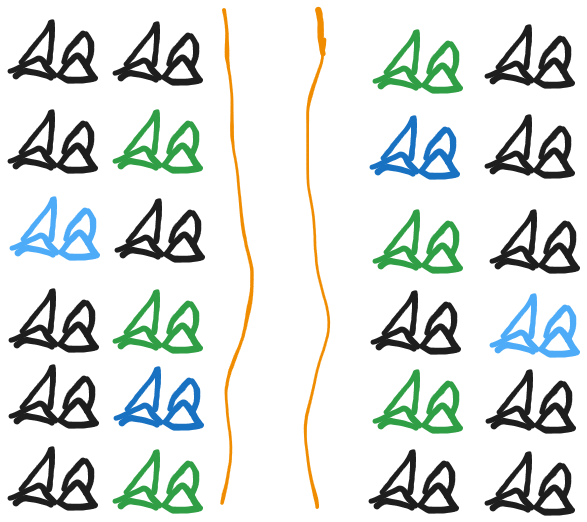
This is the main formation. Those orange lines are cart tracks. If you’ve finished the Haunted Mine quest, you’ll probably see where this is going. Those tracks are our main source of input randomness. Possessed mining carts erratically move along them, and if you stand in the way, they’ll drag you along with them, dealing damage and wasting precious time.
Now let’s zoom out.
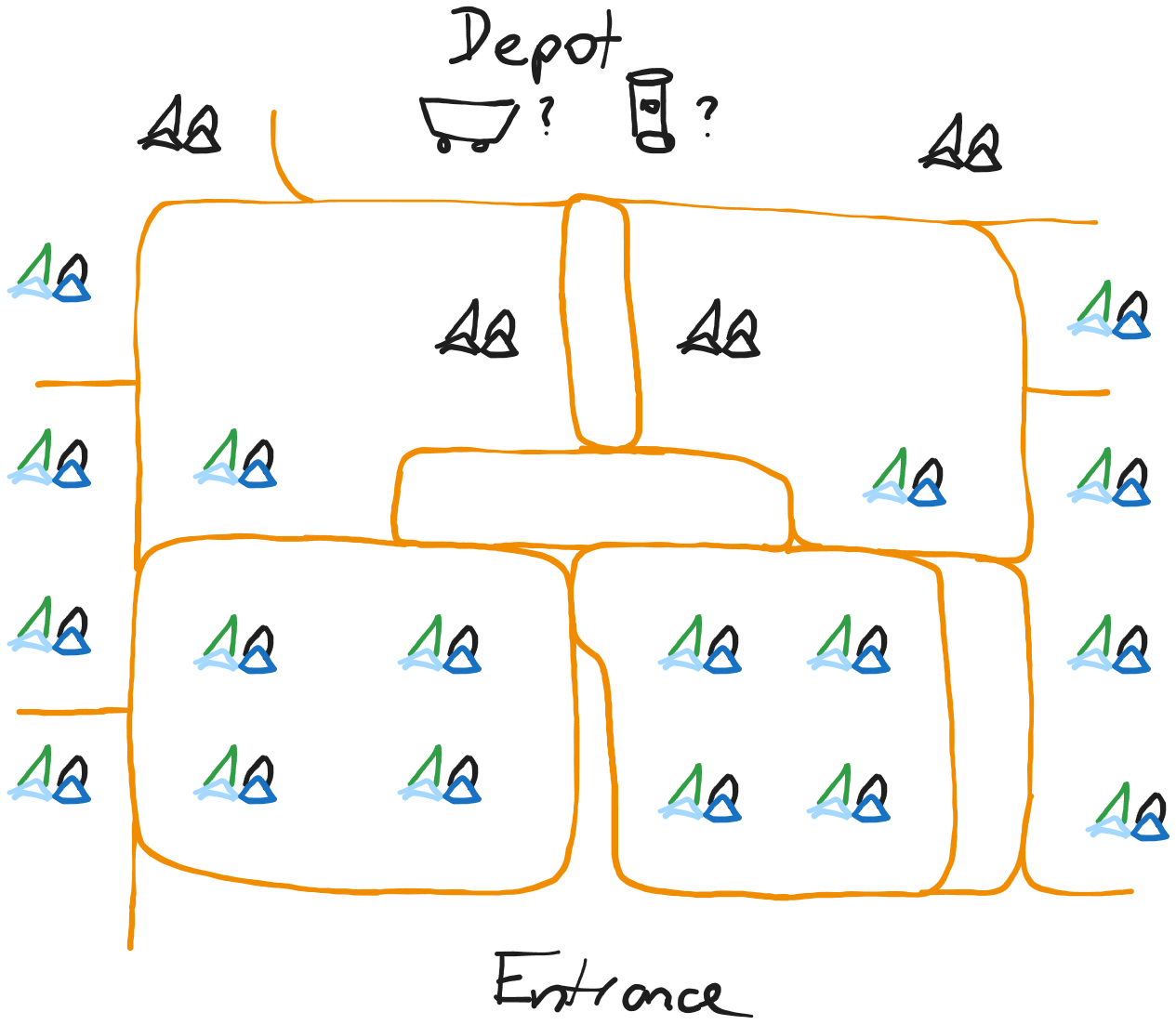
The site is arranged to be done in laps. You start at the bottom and work your way up. The highest density of valuable rocks is at the bottom, but the depot is at the top. You can of course just drop everything, but even doing this has laps based on the addy rock respawns. Moreover, because one can use Superheat Item on those rocks, that’s another thing you have to juggle, regardless of depositing.
There is enough saturation that mining gloves are not essential, but they are still an upgrade, since there are notable gaps in the wider arrangements.
With expert mining gloves, 3 players can use the site simultaneously and still get optimal saturation. This lets you do active mining with friendly company and/or competition. OSRS is an MMO after all. Imagine if you could challenge your friend to see who can get the most XP and ores/bars deposited. Mining goes from a boring chore to an engaging challenge with social elements.
So now we have: meaningful input randomness, a ~2 minute gameplay loop (laps around the site), strategic complexity (various routing choices), meaningful outputs (deposited ores/bars), permanent inputs (crystal pickaxe, mining enhancers, lightbearer, rune pouch), and consumable inputs (crystal shards, fairy dust, surge potions, runes). But we still don’t have a gameplay loop roughly corresponding to the “Trip” in PvM.
The easiest would be mechanics that tax prayer or health somehow (chip damage from falling rocks, protection prayers vs spooky ghost attacks). This is lazy though and frankly kind of boring. Now I gotta bring food too and re-bank every 20–30 minutes? Inventory management with that sounds like a real headache. And EHP would involve alts muling brews and prayer pots, which we can’t really stop without either a private instance (no more co-mining) or messy trade/aid disabling hacks.
Instead, we will do something simpler. The site is instanced, but it’s not private. Each instance can have up to 3 players, and anyone can join yours if it isn’t full. You get there by hopping onto a cart in the existing Abandoned Mine that heads into a tunnel. It leads you very deep in the mine, with the implication that there are thousands more of these sites. The excavation is collapsing fast, with rocks falling everywhere. There’s a UI on the screen showing how long until it collapses. The collapse takes 20 minutes. When it collapses, the screen fades to black, any ores or bars in your inventory are removed, and you’re back at the entrance, able to hop right back into the cart to go again. There’s no big penalty for joining late or leaving early, just enough structure to keep the monke brain happy.
The UI also shows how much mining XP you’ve gotten and how many ores/bars you’ve deposited this run, and calculates a score from these. This UI also shows the score of every other player in the mine, letting you measure your performance against other people you meet in the mine (or friends you bring along). A scoreboard out front tracks your best and average scores. Hitting a new PB becomes analogous to scoring a PvM drop, only skill gated.
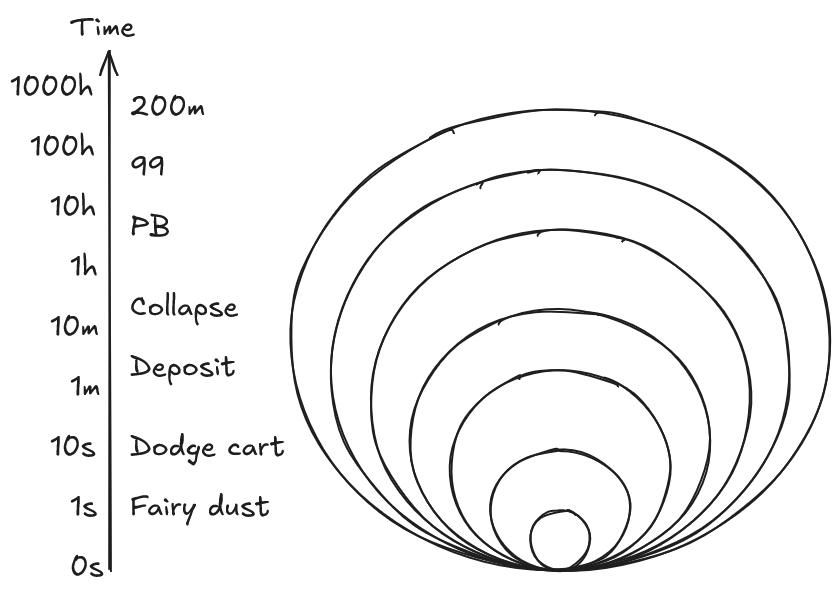
Now we’ve got a gameplay loop that looks a lot more like the PvM one.
The approach of the above suggestions is “embrace the skilling timer instead of shying away from it”. That approach is needed for Mining and Firemaking, but the framework that arrived at that works just as well for skills that don’t revolve around it. The key is to define and embrace the core activities of the skill. From there, we either put orthogonal mechanics on top to create more advanced methods, or if we’re lucky the activity itself is capable enough on its own to enable advanced variations.
This is not “minigames bad”. Methods like underwater thieving, drift net fishing, aerial fishing, Motherlode Mine, birdhouses, Zeah runecrafting, and blast furnace are just as isolated from the rest of the skill’s mechanics as any minigame. Contrast with Guardians of the Rift, Mahogany Homes, Hunters’ Rumours, and Vale Totems which build on top of the existing mechanics from those skills.
Hallowed Sepulchre invents entirely new mechanics for Agility, but rather than degenerate minigame ones (can’t make any new activities with those mechanics) it offers a wholesale new identity for Agility. One can easily imagine both “Sepulchre, but easier, for lower levels” and “Sepulchre, but even harder, for late game” and many other variants. Cooking, Crafting, Herblore, and Smithing could do with something like this that expands their scope.
Woodcutting technically has the same mechanic as Mining (one click = one resource), but it only exists on regular trees, and we don’t want two skills with the exact same mechanic. Needs a variation that matches the flavour better. One option: trees that saturate based on which face you cut from. Need to cut on all 4 faces for them to start respawning. Routing would be more complicated than with Mining since you could potentially end up with a dud site if you aren’t careful. Would also make vast forests meaningfully interactive rather than purely decorative.
Many skills have existing mechanics that are simply underutilized:
- Runecraft. Crafting essence at an altar, running/teleporting between e.g. bank and the altar in a loop. Needs mechanics on the route that you have to deal with. The Abyss somewhat does this, but it’s never been competitive. Ourania Altar does this in theory—a lazy longer route and a dangerous shorter route—but the execution is a dud because that “dangerous” route is anything but. Even if it were, the mechanics are just basic tanking instead of e.g. prayer switching, well-timed and precise movement, reacting to obstacles, etc.
- Thieving. Moving stolen goods from A to B while dodging patrols, e.g. Sorceress’s Garden, Port Piscarilius artefacts. Needs extended variants with longer lap/trip times. Guard luring for artefacts is also unnecessary comprehension complexity.
- Thieving, again. Stealing from stalls, chests, etc. when patrols are not looking. Fruit and bakery stalls are just spam clicking, with trivial patrols and short respawn times. Port Roberts stalls are a slight improvement, but still far too easy, short gameplay loop, no input randomness, and they commit the grave sin of reworking the stall stealing mechanic entirely by not being one click = one steal.
- Sailing. Needs more competitive courier tasks at endgame to make the input randomness of which tasks are available a serious routing challenge. Barracuda Trials needs a more advanced course with some input randomness.
- Fishing. Now has deep sea trawling, which could be accessible earlier and with variants focused more on getting XP rather than purely BiS fish, or variants with more interactive dangers on the routes.
- Prayer. Burying bones at an altar. POH gilded is the easily accessible variant. Chaos altar provides better XP per bone but with PvP risk. Libation bowl has same benefit but adds other inputs. What’s missing is an altar with better XP per bone/hour than POH but with PvM mechanics and a rate limit on spam clicks.
Skilling has incentives strangling it at both ends. Economic and mechanical isolation create a stable state where there’s no incentive to work on either. Fixing just the economic problem forces people into boring content. Fixing just the mechanics problem gets ignored since most people don’t engage with active pure XP skilling. The path of least resistance is simply making skilling more idle friendly to help with account progression. The debate over tick manipulation is a symptom of this much more serious problem, and it prevents both players and developers from thinking more deeply about what makes for engaging gameplay.
The missing pieces are already there. PvM has them: gameplay loops without holes; a progression ladder where complexity doesn’t shrink as you get stronger; input randomness to ward off that repetitive feeling; outputs that matter and inputs to match; and challenges built on top of mechanics players already know. We just need to bring those to skilling, and we can do that without bringing the loot casino with them.
The analysis and suggestions here are just a start, an example of that kind of thinking I’d like to see more of. Did the PvM examination give you any new ideas for active skilling? Perhaps other game design lenses that one could evaluate skilling methods by? Does training Mining in the proposed Abandoned Mine excavation sound more exciting than grinding 3t4g? Then why does every popular suggestion floating around stop at making skilling easier?